Conflicts · Kyiv, Lviv, and Moscow
Fake nuclear alerts hit Ukrainian and Russian emergency apps after Sunday night hacks
Hackers sent false radiation, chemical and nuclear warnings to users of Ukraine's air alert app on the night of 1 November. On 2 November Russia's emergency ministry said its own app had been hit by a cyberattack that sent a fake nuclear alert to 33 regions.
AI text based on reports by Deutsche Welle, Irish Independent, Ziare.com and other publishers. Changed . How it is made
 Pollar Films · recorded Nov 2
For membersThe first 30 seconds for everyone. Synthetic voice (AI).
In brief
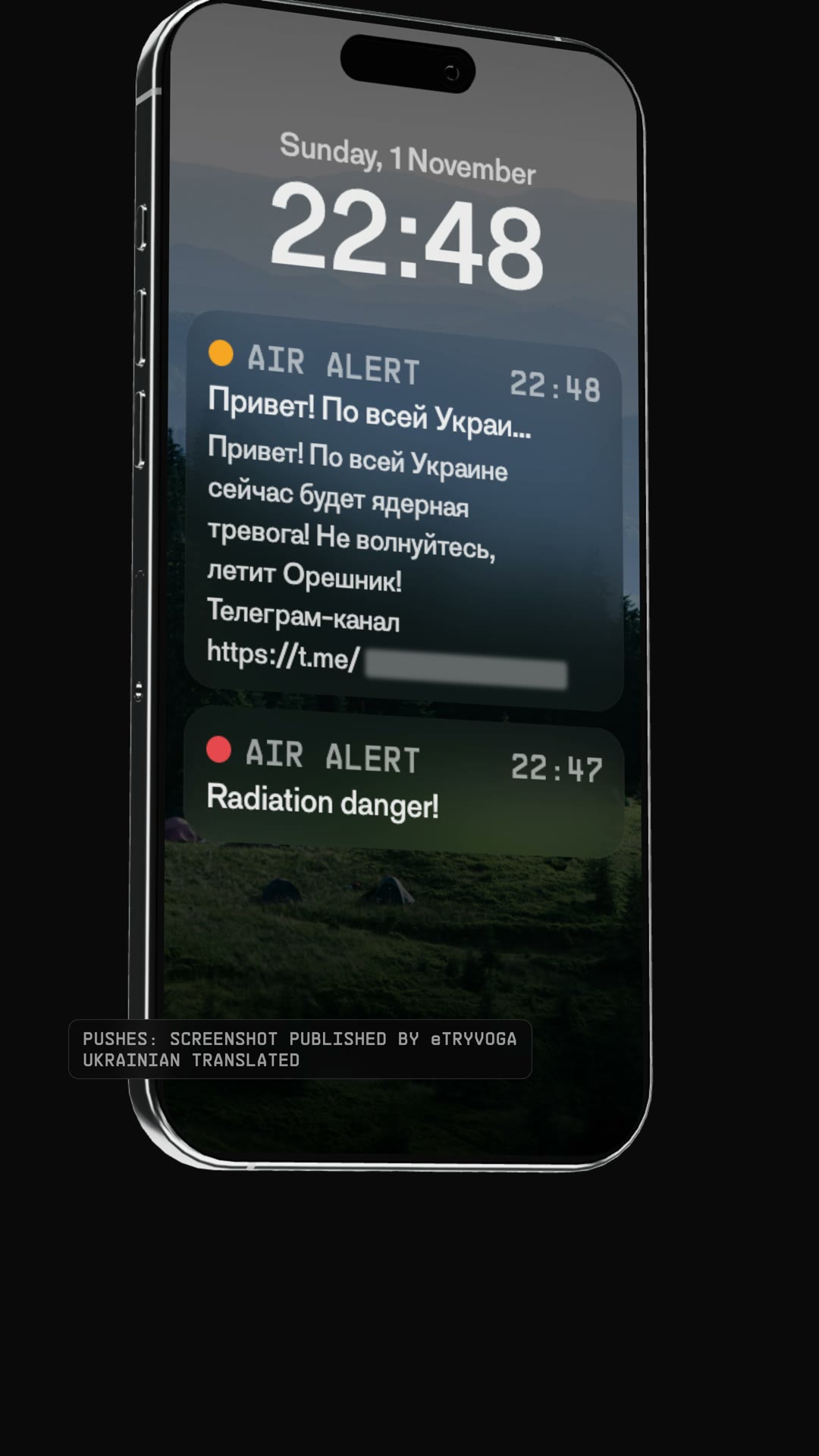
Fake messages reached users shortly before 23:00 on 1 November warning of radiation, chemical threats and street fighting in Kyiv. Ukraine's Air Force said within 15 minutes that there was no radiation threat, but the all-clear took more than an hour.
Russia's Emergency Ministry reported a massive cyberattack on its mobile app on 2 November. The false alert claimed nuclear warheads had been launched in all regions of Russia.
Zelensky told PBS News in an interview on 2 November that Ukraine had hacked Russia's emergency alert system in response. A Telegram claim that the Hitcore group took responsibility has not been independently verified.
- 1 November, before 23:00Fake alerts begin reaching users of Ukraine's air alert app
- 1 November, within 15 minutesUkraine's Air Force says the app was compromised and there is no radiation threat
- 2 November, morningRussia's Emergency Ministry reports a massive cyberattack and a false alert sent to 33 regions
What the alerts said
Shortly before 23:00 local time on 1 November, users of Ukraine's public air alert app began receiving false notifications. The messages, written in Ukrainian and in English (the English version with spelling mistakes), warned of radiation and chemical threats, street fighting in Kyiv and an Oreshnik missile attack. Some were written in Russian, and one linked to a Telegram channel apparently owned by a hacker group. Ukraine's Air Force said within 15 minutes that the app had been compromised and that there was no radiation threat, but more than an hour passed before "all clear" messages were sent. The app's operators said unauthorised persons had interfered with it, that notifications were disabled and that the service was temporarily suspended.
Stepan Tanasiychuk, coordinator of the Ukrainian air alert project, said on 2 November that the service was being gradually restored, with new yellow and red alert levels now shown on the map. He said the team was taking extra steps to prevent similar incidents and acknowledged the anxiety the false alert had caused.
Russia's emergency app
Russia's Emergency Ministry (EMERCOM) said early on 2 November that its mobile app had been hit by a "massive cyberattack" that spread false information to the public, as reported by TASS. A false alert reached 33 regions and claimed that nuclear warheads on P1-SUN launch systems had been fired in all regions of Russia, ending with a warning full of insults. Russian officials said hackers had gained access to the ministry's app, which is based in Moscow. Few people appear to have believed the messages, though some commenters suggested the episode had undermined trust in official warnings. One Russian user said they had deleted the EMERCOM app and would never install anything like it again.
Who is responsible
Early reports said neither country had claimed responsibility, and it was unclear where or how the incidents started. Officials and analysts have widely interpreted the episode as tit-for-tat attacks started by Russia. In a PBS News interview on 2 November, Volodymyr Zelensky confirmed that Ukraine had hacked Russia's emergency alert system, saying Kyiv was only responding to attacks on its own app. A hacker within Ukraine's "hacktivist" community told the BBC that the breach of the Russian system was likely a retaliatory attack. The Guardian, citing unverified claims from a Telegram channel close to the Kremlin, said the Hitcore hacker group could be involved. Mash, a Russian Telegram channel said to have security service links, reported that Hitcore representatives had claimed responsibility, a claim that has not been independently verified.
Cyber conflict in numbers
Ukraine's security service (SBU), citing its cybersecurity department, said more than 16,000 Russian cyberattacks and "critical cyber incidents" had been neutralised between February 2022 and July 2026. Brigadier General Volodymyr Karasteliov described a three-hour DDoS attack against a nationwide Ukrainian television channel.
“The botnet generated up to 200,000 requests per minute from nodes in Asia, Europe and the United States.”
Cybersecurity firm CybelAngel's REACT team recorded 1,651 cyber incidents targeting Ukrainian entities and 575 targeting Russian entities between January 2025 and January 2026.
- Targeting Ukrainian entities
- 1651 incidents
- Targeting Russian entities
- 575 incidents
Data from the article text
Public reaction
The BBC reported that Ukrainians have grown weary of air alerts about drones and missiles, so many did not take the fake messages seriously. Sofia Kochmar, a 34-year-old mother in Lviv, said she was frightened by the word "nuclear" but doubted the alerts once they mentioned street fighting in Kyiv. Yevhen Baliutov, a cybersecurity expert at Kyiv School of Economics, told the BBC it was clear to him that Russians had hacked the system. He said many Ukrainians had clicked a link leading to a Russian Telegram channel, exposing them to disinformation, phishing attempts or data breaches.
“This is a war, so it's no surprise that Russia will try to hack, will try to send us fake news”
The attack came on the same day the humanitarian ceasefire in the Russian-occupied city of Oleshky officially ended, the BBC reported.
- An earlier version said the IAEA had blamed Russia for the drone attack that killed a worker at the Zaporizhzhia nuclear plant; the agency did not say who carried it out.
- An earlier version said there had been no Kremlin reaction; on 30 October Russian officials said Ukraine had resumed strikes on refineries and accused Kyiv of ignoring Trump's request.
This article is part of a thread
Russia and Ukraine: the push for talks
What changed since this entry:
- 15/11Lavrov says Russia will negotiate toward Putin's June 2024 aims; Peskov demands new European security architecture
- 15/11Zelensky says Russian negotiators lacked authority on some issues and Moscow opposed an energy ceasefire
- 15/11US official says Donbas-for-NATO ideas remain under discussion and need both sides' consent
Ask about this text
Sources and context
- Deutsche WelleZelenskyy confirmed the breach of the Russian alert systemЗеленський підтвердив злам російської системи оповіщення · original in Ukrainian
- Irish IndependentMaira Butt: Cyberattack is a desperate bid by Putin to cause civilian panic
- Ziare.comAlert apps in Russia and Ukraine were hacked. Hackers sent fake messages about nuclear, chemical threats and missile attacksAplicațiile de alertă din Rusia și Ucraina au fost piratate. Hackerii au transmis mesaje false despre amenințări nucleare, chimice și atacuri cu rachete · original in Romanian
- Courrier internationalRadioactive danger: cyberattacks target Russian and Ukrainian emergency appsDanger radioactif" : des cyberattaques visent les applications d'urgence russes et ukrainiennes · original in French
- Volodymyr Zelensky
- President of Ukraine, who confirmed in a PBS News interview that Ukraine hacked Russia's emergency alert system
Pollar is free and carries no ads in the text. Its members keep it going.
Support Pollar